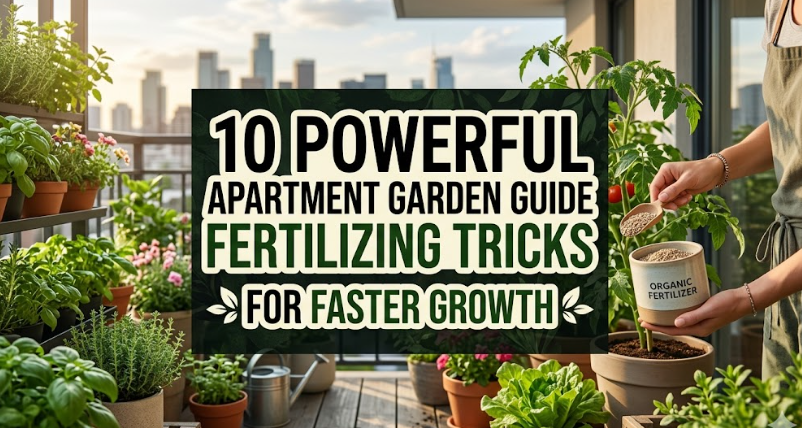
Fertilizing Tricks to Make Your Apartment Garden Plants Grow Faster
It can seem a little tricky growing plants in a small apartment. Space is tight. Sunlight is limited. And your plants rely solely on you for their sustenance.
That’s where smart fertilization comes into play.
Most apartment gardeners regularly water their plants but often forget to feed them as well — and that’s exactly why plants grow slowly or stop thriving completely.
This apartment garden guide addresses fertilizing — the magical elixir for faster, stronger, healthier growing plants. Whether you’re growing herbs on a kitchen counter or vegetables on a balcony, these 10 tricks will get you off to the right foot.
Let’s get into it.
Why Fertilizing Your Plants Is a Game-Changer
Plants produce their own food from sunlight via photosynthesis. But they also require nutrients from soil to thrive.
Outside, in a garden, soil replenishes nutrients over time. In an apartment, your plants are confined to the same pot of soil. That soil gets depleted fast.
When watering is done repeatedly, nutrients leach out of the pot. After the first few weeks, the soil has very little left to give.
Fertilizing replaces those nutrients. It provides your plants with the building blocks they require — nitrogen for foliage, phosphorus for roots and flowers, and potassium for general strength.
Even the best-lit apartment plants will slowly starve without fertilizing.
The 3 Key Nutrients All Plants Need (Simple N-P-K Breakdown)
Before getting to the tricks, you need to know what is in fertilizer.
All fertilizer labels contain three numbers — for example 10–10–10 or 5–3–4. These numbers stand for:
- N = Nitrogen — leaf and stem growth
- P = Phosphorus — root strength and blooming
- K = Potassium — disease resistance and general health
Now that you know what nutrients do, let’s look at the 10 fertilizing hacks that will actually get your plants’ growth rate up.
Tip #1 — Use the Right Fertilizer for Your Plant Type
Not every fertilizer is suitable for every plant.
Leafy plants such as basil, mint and spinach require more nitrogen. Fruiting plants like tomatoes and peppers require additional phosphorus and potassium. Succulents require very few nutrients, if any.
How to pick the right one:
- Herbs and leafy greens → Use a high-nitrogen fertilizer (such as 10-5-5)
- Tomatoes and peppers → Balanced or bloom fertilizer (like 5-10-10)
- Succulents and cacti → Feed monthly with diluted, low-nitrogen fertilizer
- Flowering plants → Super phosphate fertilizer during the budding phase
Once you’ve matched the right fertilizer to the right plant, you can see faster, fuller growth almost immediately.
Tip #2 — Always Use Liquid Fertilizer at Half Strength
This is one of the most common apartment gardening mistakes.
Using fertilizer at full strength in a small pot will build up nutrients quickly. The soil becomes too concentrated. That actually burns roots and harms your plant — a condition known as fertilizer burn.
The solution is easy: always dilute liquid fertilizer to half the recommended strength.
If the label says “1 tablespoon per gallon,” use ½ tablespoon instead.
This allows you to feed your plants more often without the danger of overwhelming them. It provides a steady, gentle influx of nutrients instead of one big shock.
Feeding at half strength every two weeks is far superior to feeding at full strength once a month.
Tip #3 — Fertilize Your Plants in the Morning
Timing matters more than many people realize.
Most plant activity occurs in the morning. Their pores (called stomata) are open. They’re soaking up light and starting photosynthesis. That is when they are most ready to take on nutrients.
Fertilizing in the morning means your plants can use those nutrients at their most active time of day.
Fertilizer applied overnight is less effective. The plant is in rest mode. Nutrients sit in the soil longer and are more prone to accumulate or leach during the next watering.
Make fertilizing a morning routine. Combine it with watering for optimal results.

Tip #4 — Treat Worm Castings Like a Slow-Release Powerhouse
Worm castings are essentially worm poop — and they’re amazing for apartment plants.
They are dense in nutrients but come in slow-releasing form. They improve soil structure and release beneficial microbes that aid root nutrient uptake.
You don’t need a lot. Simply work in a small amount (roughly one tablespoon per pot) into the top layer of soil every four to six weeks.
There is no risk of burn or toxicity with worm castings, no matter how much you use. That makes them favorites of beginners who worry about over-fertilizing.
Worm castings are available at garden centers, plant stores, or online. They’re inexpensive and keep for quite a long time.
Why worm castings are better than standard slow-release pellets:
| Feature | Worm Castings | Synthetic Slow-Release Pellets |
|---|---|---|
| Burn risk | None | Possible if overdone |
| Soil microbes | Yes, benefits soil life | No |
| Nutrient release | Gentle and consistent | Spikes can happen in heat |
| Smell | Earthy, mild | Can be chemical |
| Safe for edibles | Yes | Check label first |
Tip #5 — Brew Your Own Compost Tea (Free and Simple)
You don’t have to spend money on expensive fertilizers.
Compost tea is a liquid fertilizer made at home from compost. It’s free, 100 percent organic, and shockingly potent.
Here’s how to make it:
- Fill a bucket with water. Let it sit for 24 hours to allow the chlorine to evaporate.
- Place a handful of compost or worm castings in a mesh bag or an old cloth.
- Dip the bag in and out of the water like a tea bag.
- Steep for 24 to 48 hours.
- Remove the bag and use the brown liquid to water your plants.
This liquid is rich in nutrients and beneficial bacteria. Use it every two weeks for a regular feed.
Even if you live in an apartment without outdoor space, you can maintain a small compost bin or vermicomposter (worm bin) indoors to provide a never-ending supply of compost for this purpose.
Tip #6 — Feed More in the Growing Season, Less in Winter
Most plants do not grow at the same rate all year, even indoors.
In spring and summer, sunlight is stronger and daylight lasts longer. Plants are actively growing and require additional nutrients to support that growth.
In autumn and winter, light falls. Growth slows down dramatically. Plants enter a semi-dormant state. Overfeeding them during this period causes nutrients to build up in the soil, which can damage the roots.
The general rule: Fertilize every two weeks in spring and summer, but cut back to monthly — or stop altogether for slow-growing plants — in fall and winter.
Watch your plant for signals:
- Pale new leaves = nutrient deficiency
- Brittle growth or brown leaf tips = too much fertilizer
Tip #7 — Feed Your Plants Potassium with Banana Peel Fertilizer
Here’s a free hack straight from your kitchen.
Banana peels are loaded with potassium — one of the three primary nutrients that plants require. Potassium helps plants build strong cell walls, resist disease, and produce better fruit and flowers.
There are two ways to use banana peels:
Option A — Banana peel water: Place one or two banana peels in a jar full of water and let them soak for 48 hours. Then use that water to nourish your plants.
Option B — Dried, crushed peels: Allow the peels to dry thoroughly (in sunshine or in a low-heat oven) and then crush them into flakes. Work them into your top soil layer.
This is particularly effective with flowering plants, tomatoes, and peppers while they are producing fruit. It’s totally safe, organic, and uses something you would otherwise throw away.
Tip #8 — Never Fertilize a Dry Plant
It’s a simple rule that saves plants every single day.
Never apply fertilizer — liquid or granular — to dry soil.
When the soil is dry, the roots are stressed. Pouring concentrated nutrients onto stressed, dry roots burns them immediately. The plant simply can’t handle it.
Always water your plant first. Wait a few minutes. Then apply fertilizer to moist soil.
The moisture helps distribute the nutrients evenly through the soil and delivers them gently to the roots. It reduces the risk of burning and makes the fertilizer significantly more effective.
If you are using liquid fertilizer, many gardeners mix it directly into their watering can and feed while watering. This works especially well in apartment settings.
Tip #9 — Flush Your Soil Every Three Months
Even if you follow every rule above, salts and minerals will still accumulate in your potting mix from fertilizer over time.
If you notice white crusty deposits on top of your soil or around the drainage holes of your pot, that’s salt buildup. It acidifies the soil and prevents roots from taking up water properly.
The remedy is a straightforward soil flush:
- Place your pot in the sink or bathtub.
- Pour water slowly through the soil — about three times the volume of the pot.
- Let it drain completely.
- Do not fertilize again for one week.
Do this every three months and your soil will stay clean, healthy, and ready to support strong growth.
It’s a step that many apartment garden guides omit, yet it really matters for the long-term health of your plants.
Tip #10 — Create a Fertilizing Schedule (and Stick to It)
The most underrated trick in apartment gardening is consistency.
Plants thrive when nutrients arrive on a regular schedule. One good feeding followed by six weeks of nothing is far less effective than small feedings every two weeks.
The trouble is — it’s easy to lose track.
The solution: establish a basic timetable. Put it on your phone calendar or write a note and stick it to the fridge. Designate every two weeks as “plant feeding day.”
Adjust based on your specific plants. Tomatoes and herbs in summertime may need feeding every 10 days. Cacti in winter can go 8 weeks with nothing at all.
All 10 Tips at a Glance
| Tip | What to Do | Best For |
|---|---|---|
| 1 | Match fertilizer to plant type | All plants |
| 2 | Always dilute to half strength | All liquid fertilizers |
| 3 | Fertilize in the morning | All plants |
| 4 | Use worm castings | All pots, especially beginners |
| 5 | Brew compost tea | Those with a compost bin |
| 6 | Adjust feeding by season | All apartment plants |
| 7 | Use banana peel fertilizer | Flowering and fruiting plants |
| 8 | Never fertilize dry soil | All plants |
| 9 | Flush soil every three months | All pots |
| 10 | Create a fertilizing schedule | All apartment gardeners |
Signs That Your Plant Is Hungry (and Signs That You’ve Overfed It)
Knowing when to act is as critical as knowing what to do.
Your plant needs more fertilizer when you notice:
- Yellowing leaves (especially older, lower leaves)
- Slow or stunted growth despite plenty of light
- Smaller-than-usual leaves
- Weak or droopy stems
You’ve overfertilized your plant if you notice:
- Brown, crispy leaf tips
- Whitish crust on the soil surface
- Wilting even in moist soil
- Sudden leaf drop
When in doubt, less is more. It’s far easier to help an underfed plant than one experiencing fertilizer burn.
Organic vs. Synthetic Fertilizers: How to Choose
Both work. However, the choice depends on your goals and lifestyle.
Organic fertilizers (worm castings, compost tea, banana peels, fish emulsion) release nutrients slowly. They build soil health over time. They are safe for edible plants and better for the environment. They may have a slight smell — worth considering in a small apartment.
Synthetic fertilizers (most liquid fertilizers found at garden stores) deliver nutrients quickly. They’re precise and consistent. They’re excellent when your plant needs a fast boost. However, they build up salt faster and require more careful use.
A combination of both is ideal for long-term apartment garden results. Feed regularly with organic methods, but supplement with synthetic fertilizer when a plant needs a quick fix.
The Best Fertilizers for Popular Apartment Plants
| Plant | Fertilizer Type | Frequency |
|---|---|---|
| Basil & mint | High-nitrogen liquid | Every 2 weeks in growing season |
| Tomatoes | Bloom fertilizer (high P & K) | Every 10 days in summer |
| Succulents | Diluted balanced fertilizer | Once a month in spring/summer |
| Pothos / philodendron | Balanced liquid (10-10-10) | Every 3–4 weeks |
| Peace lily | Low-nitrogen liquid | Monthly in spring and summer |
| Chili peppers | High-K fertilizer during fruiting | Every 2 weeks when fruiting |
How Light Affects Fertilizer Absorption
Here is something that most apartment garden guides overlook.
Plants cannot utilize nutrients without photosynthesis — and photosynthesis requires light. That means light and fertilizer are inseparable.
If your plant is sitting in a dark corner with minimal light, fertilizing isn’t going to do much good. The plant is unable to process the nutrients properly. The fertilizer simply sits in the soil.
Ensure your plant is getting enough light before applying more fertilizer. Even moving a plant 2 feet closer to a window can make a significant difference in how well it utilizes the food you’re giving it.
If you live in an apartment with limited natural light, grow lights are an excellent solution. A simple LED grow light used for a few hours each day can have a greater impact than any fertilizer tip on this list.

A Note on Watering and Fertilizing at the Same Time
Watering and fertilization are interdependent.
Water too often, and nutrients wash out of the pot before roots can absorb them. Too little water leads to salt buildup that damages the roots.
The objective is soil that is well-hydrated but not waterlogged. Water when the top inch of soil feels dry. On feeding days, mix your liquid fertilizer into the watering can and do both at once.
This simplifies your routine and ensures that nutrients are always delivered to moist, receptive roots.
Common Fertilizing Mistakes to Avoid
Even seasoned gardeners make these mistakes:
- Fertilizing newly repotted plants — Potting mix usually comes with nutrients built in. Do not fertilize until 6 weeks after repotting.
- Fertilizing a sick plant — A diseased or root-damaged plant will not take up nutrients. Fertilizing it stresses it further. Fix the root problem first.
- Skipping the growing season — Your plants need the most support in spring and summer. Do not miss feedings during this period.
- Using garden soil fertilizer on indoor plants — Garden fertilizers are designed for outdoor soil conditions. They can be too concentrated or the wrong formula for pot-bound apartment plants.
Fertilizing FAQs
How often do I need to fertilize my apartment plants? In spring and summer, feed most plants every two weeks with half-strength liquid fertilizer. In fall and winter, cut back to once a month or pause completely for slow-growing plants.
Can I use too much fertilizer? Yes. Over-fertilization leads to fertilizer burn — leaf tips turn brown and the plant wilts despite moist soil. Always dilute liquid fertilizer to half strength, and flush your soil with plain water every three months to remove excess salts.
How effective is banana peel fertilizer? Very effective for boosting potassium. Soaking banana peels in water for 48 hours leaches out a good amount of potassium — an essential nutrient for flowering and fruiting plants. It is best used during the flowering stage.
Which fertilizer is best for beginners? Worm castings are perfect for beginners. They won’t burn your plants, they improve soil health, and they release nutrients slowly and steadily. Work a tablespoon into your top soil every four to six weeks.
Do succulents need fertilizer? Succulents need very little fertilizer. Feed them once a month in spring and summer with a diluted balanced fertilizer. Do not fertilize in fall or winter, when they are not actively growing.
Do I need to fertilize plants in low light conditions? Plants growing in low light do not need much fertilizing. They process food slowly because they can only use nutrients when photosynthesizing. In low light, fertilizer can build up and cause salt damage. Improve the light first, then feed.
Why are my plant’s leaves turning yellow? Yellowing leaves can indicate a nitrogen deficiency, especially if it begins with older leaves at the bottom. However, yellow leaves can also indicate overwatering, so test soil moisture before rushing to fertilize.
Final Thoughts: Your Apartment Garden Needs Regular Feeding
Fertilizing is not complicated. But it does require consistency and the right approach.
This guide has taken you through 10 tried-and-true fertilizing tricks — from choosing the right formula and timing, to making kitchen-scrap fertilizers and sticking to a schedule.
The biggest lesson is this: frequent light feeding trumps occasional heavy feeding every time.
Try one or two tricks at a time. Start with half-strength fertilizer or morning feeding. Watch how your plants respond. Then build from there.
Your apartment plants are relying on you for everything — water, light, and nutrients. Give them regular care, and they’ll reward you with quicker growth, more blooms, and a greener, healthier space to live in.
Happy growing.